
The new reseller-centric supply chain - Workplace360
Weren’t resellers always at the heart of everything in the workplace supplies industry? Simply put, no. Distributors and wholesalers dominated the previous model and access to them and their operational network, marketing and data was critical to the success of manufacturers and resellers alike.
Many of the big themes of the day reinforced that distributor focus: catalogue listings, stockless models, full-service expansion, annual rebate negotiations ahead of product selection meetings – and does anyone remember Bokz?
The first real pressure came from the manufacturers as new routes to market opened up. Distributors struggled to retain the supply chain control that they had exerted in a catalogue-driven industry as the market evolved. In-house websites, content and marketing tools couldn’t keep pace, while catalogue relevance and circulation fell. Physical warehousing limitations also meant that new categories were never comprehensive enough. One decision defines that changing dynamic: Pilot Pen and ExaClair left the Spicers catalogue, thrived and were asked to return within 12 months.
The beginning of the end
The growth of consumer e-commerce highlighted the contrast with the status quo. Many OEMs gained direct end-user access, with no range limitations, no launch windows and more effective campaigns. They became masters of their own content and gradually adapted to deliver smaller parcels. This meant that beneath the surface, the capability to deal directly with resellers was being built. For resellers, it became increasingly difficult to run a business tied solely to a wholesaler and the race for diversification was on.
This diversification trend drove the sustained fragmentation of the old supply chain as resellers built other sourcing solutions outside OP distribution. In some durables categories, such as furniture, this was easier because established UK supply chains already existed. This was a necessity in areas such as services, where wholesalers abandoned attempts to fulfil that need.
However, where distributor capabilities materially expanded – for example, in cleaning and hygiene – the pace of change was slower. Then the pandemic, forcing rapid diversification and new sourcing solutions, accelerated these trends to their conclusion, firmly establishing resellers as the gatekeepers to market access.
Now, following the demise of Exertis Supplies as the last broadline, trade-only OP wholesaler, the old linear supply chain has come to an end. The challenge for suppliers, manufacturers and distributors is how to offer products in the different ways that resellers need to buy and deliver them to end users. If you only have one option, you will be left behind.
Suppliers now need a portfolio of stocked, back-to-back, direct delivery, virtual and stocked distribution solutions. Plus, they must be able to communicate and support those choices, enabling resellers to access their complete range competitively and flexibly; to be there when and where they are needed.
Follow the clusters
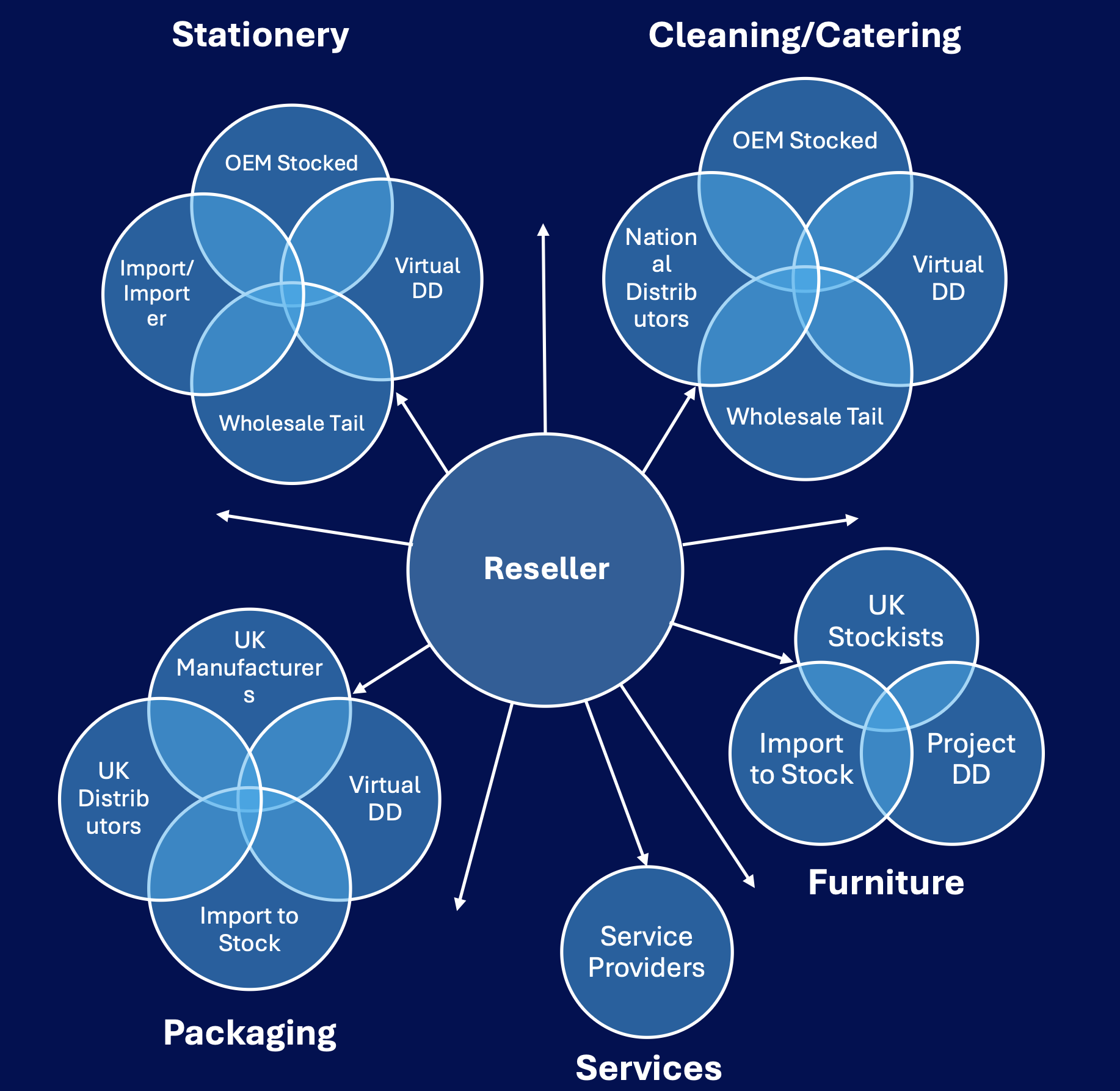
For resellers, the pace of supplier, category, product and customer diversification will continue. Supply chains will increasingly form category clusters that utilise a mix of manufacturers, importers, distributors and service providers to create a comprehensive offering. Recognising this trend provides a framework for improving category buying strategy and answering questions such as:
- Where can I move up the supply chain to the right supplier?
- Are there enough vendors and specialist distributors?
- Do I understand the full direct opportunity with key brands?
- Where and when do I consolidate versus maximise best price?
- Do I have access to enough breadth of products and services in developing areas?
A simple cluster model helps resellers to visualise where each supplier type fits and where gaps or overreliance exist. To explore this approach further, start with a key category that is driving sales growth. Then build a quick cluster map of which suppliers should be fulfilling which parts of the range. Here is an example of a cluster split by supplier type and their primary and secondary functions:
- Brands: Core branded lines and main range durables.
- UK vendors: Core contract lines and bespoke.
- Overseas manufacturers or import consolidators: Core contract lines.
- Wholesalers: Main range consumables, core branded lines.
- Virtual distributors: Main range durables, core branded lines.
- Service partners: Services.
By identifying the role that each supplier plays, resellers can quickly see whether sourcing aligns with business needs. It also fast-tracks the identification of anomalies and opportunities around cost, consolidation, range, sourcing and new relationships, while providing fresh insight into sales performance.
The new world order
Resellers now sit firmly at the centre of the industry as the key to unlocking manufacturer success. Therefore, how resellers manage that supply chain and maximise the benefits and opportunities has become a central challenge. The diversification trend is set to continue to dominate product strategies; while at the same time, the number of suppliers and the variety of supply chain solutions available to resellers keep expanding.
Resellers: now is the time to rethink processes, invest in people and accelerate expertise in core clusters to improve competitiveness and maximise sales. Suppliers: get your positioning, solutions and communications right if you want to succeed.
This article first appeared in Workplace360 magazine in June 2026. https://workplace360.co.uk/imo-the-new-reseller-centric-supply-chain/