
Can I Buy from Asia
For many SME resellers, the idea of importing directly from Asia feels both tempting and intimidating. The potential benefits are clear: better pricing, differentiated products, and more control over your range. However, buying in containers is not just a clean removal of the “middleman”. It’s a strategic decision that affects cashflow, operations, quality assurance, compliance and customer service.
If you’ve ever wondered whether your business is ready, or even suited, to buy direct, it’s worth breaking the question down into a few practical considerations.
Do I Have the Volume?
Container buying only works when the numbers work. That means:
- Sufficient annual volume to justify multiple full or part‑container loads
- Predictable demand so stock doesn’t sit on the floor for months
- A clear view of your top sellers and the confidence they’ll continue to move
A common misconception is that you need to fill a 40ft container with a single SKU. In reality, you can mix products but you still need enough throughput to make the numbers stack up. If your volumes fluctuate heavily or you rely on opportunistic buying, direct import may create more risk than reward.
A critical question is ‘can I manage the second order?’. Products rarely sell uniformly to forecast. Therefore, how do I manage replenishing the first out-of-stock whilst ordering in container volume, or do I have a local source I can draw on to balance out the demand.
A basic start point is to calculate the volume across your fastest selling products and ranges to understand your demand in containers and how that would flow across a year. 1 or 2 a year probably won’t work unless you are committing to grow the volume based on the new price or you can find a partner to share the volume on arrival. If you require >1 a month then that is ideal.
Box Volume Calculation
Box length (m) x width (m) x height (m) = volume CBM
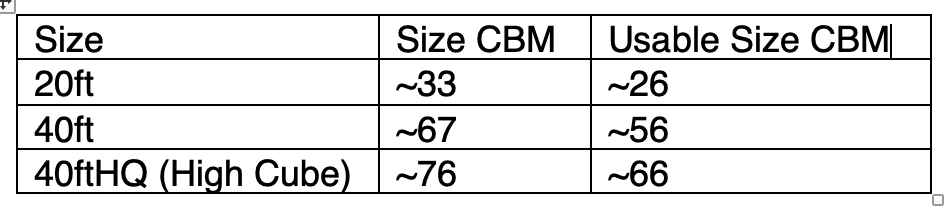
Standard Container Sizes
Notes
- An LCL is Less than a Container Load, i.e. the container is shared with other companies.
- Products palletised in containers reduces the usable CBM but speeds up your goods in handling on arrival.
- Containers must adhere to weight restrictions on UK or Irish roads. Therefore, heavy/dense products (e.g. batteries) tend to use 20ft containers and can be shipped part empty to stay within weight restrictions.
Can I Ensure the Quality?
Quality control is the make‑or‑break factor in Asian sourcing. You’re not just buying a product, you’re buying a process.
To get it right first time, you’ll need:
- Clear specifications
- Pre‑production samples and signed‑off standards
- Factory audits and/or third‑party inspections
- A plan for what happens if something isn’t right
Good suppliers welcome scrutiny and want to provide independent reassurance of their capabilities. If a manufacturer resists transparency, that’s a red flag. Remember, the biggest brands build the most technical products in factories in Asia, judge the factory not the location.
Importantly, quality issues discovered after arrival are expensive, slow to resolve, and costly, so, the checks must happen before the goods leave the factory. There are many international and local independent organisations that will visit, inspect and report on a shipment pre-delivery.
Am I Compliant?
One of the biggest shifts when importing, compared with buying from a local distributor, is that you become legally responsible for product compliance. That means ensuring every item you place on the market meets all relevant safety, labelling, environmental, and regulatory requirements for the countries you sell into.
This includes:
- Correct and complete labelling and warnings
- Compliance with safety standards and testing requirements
- Any required registrations, licences, or declarations
- Maintaining any technical documentation and keeping it up to date
- Being able to provide information to enforcement authorities on request
- Having a product recall process in place should something go wrong
Crucially, “I didn’t know” or “the factory told me it was compliant” is not a defence. As the importer, you are the responsible person.
A methodical approach helps: understand your obligations, take advice from supply partners and trade associations then validate it, and use third‑party testing or inspection services where appropriate. The objective is certainty, not assumption.
Useful guidance includes:
- EU General Product Safety Regulation (EU & NI) https://www.gov.uk/government/publications/general-product-safety-regulations-northern-ireland/eu-regulation-2023988-on-general-product-safety-detailed-guidance
- UK HSE Guidance on Supplying Products https://www.hse.gov.uk/work-equipment-machinery/uk-law-design-supply-products.htm
How Do I Get the Delivery?
Shipping from Asia is a process with multiple moving parts:
- Production lead times (typically 30–60 days but longer for your first order)
- Sea freight transit (around 40-55 days depending on port and route)
- Customs clearance and duties (1-3 days)
- Final delivery to your warehouse
You’ll need to decide the terms of trade for the shipment, called the Incoterms (https://www.gov.uk/guidance/customs-valuation/incoterms), simply put, whether to buy FOB (you control the freight) or CIF (the supplier arranges it). Neither is inherently better but FOB is the norm in business supplies. This process requires a legal exchange of shipping documents and this is done through a Freight Forwarding business. There are many reputable ones to choose from in the UK and Ireland.
Duty rates are available for the UK at https://www.gov.uk/trade-tariff and for EU at https://taxation-customs.ec.europa.eu/customs/customs-tariff/eu-customs-tariff-taric_en
How Do I Pay?
Payment terms are very different from buying domestically. Expect:
- Deposits on order (often 20–30%)
- Balance before shipment or whilst the container is in transit
- As you build a relationship over multiple orders the deposit will no longer be required and, eventually, you will pay between 30-90 days after shipment. It is important to establish that future requirement at the start of the relationship to avoid issues later on.
- In addition, you will normally be paying in US$. Therefore, the cost in Sterling or Euros will be different on the day you pay compared to the day you placed the order due to currency movements. You can consider hedging currency to manage the risk of currency movements.
Therefore, the combination of higher stock holding and earlier payment for goods means working capital is impacted, and has to be accounted for in the full product cost. The landed cost (delivered to your premises) of a product is more than the unit price, it includes freight, duty, inspection fees, and sometimes unexpected surcharges. Understanding your true total cost is critical before you commit.
How Do I Choose Between a Manufacturer and a Consolidator?
Manufacturer
- Best for: stable, high-volume SKUs
- Pros: lowest unit cost, direct control, long-term partnership potential
- Cons: higher MOQs, more responsibility on you for QC and freight
Consolidator / Trading House
- Best for: mixed ranges, lower volumes, or early-stage importers
- Pros: easier to start, lower MOQs, one point of contact, consolidated shipments, prior experience of suitable factories
- Cons: slightly higher pricing, less visibility into the factory
Traditionally, many SMEs start with a consolidator to learn the process, then move to direct manufacturing once volumes justify it. A more recent consideration is the subdivision between the major product factories (possibly +$1bn turnover) and the trust they can provide versus smaller players where you need to own more of the risk.
Conclusion
Buying from Asia can be a powerful lever for margin, differentiation, and long-term competitiveness but it’s not always a solution. It requires volume, planning, discipline, and the right partners. For some resellers, it’s a natural next step. For others, it’s a distraction from what they do best.
Finally, if you’re considering whether direct import could work for your business, and want practical, experience-led support on the risks, opportunities, and options then get in touch.